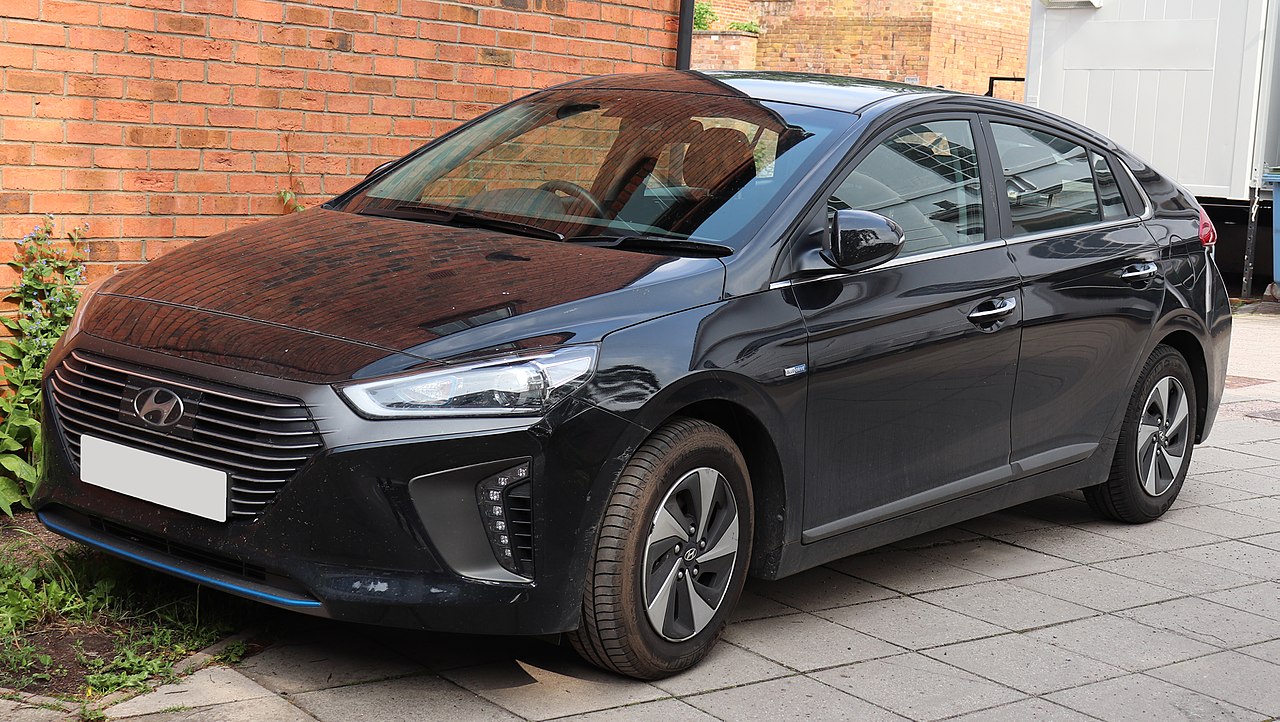
Photo: Vauxford, CC BY-SA 4.0, via Wikimedia Commons Photo: Malopez 21, CC BY-SA 4.0, via Wikimedia Commons Photo: Malopez 21, CC BY-SA 4.0, via Wikimedia Commons Photo: Malopez 21, CC BY-SA 4.0, via Wikimedia Commons
Verdict
Family hatchback available as a hybrid, plug-in hybrid and electric, rated 5 stars by Euro NCAP in 2016. Carverif considers it generally reliable, provided the DCT6 gearbox of the hybrid versions is tested when cold. Several safety recalls have affected it (power relay of the hybrids, high-voltage battery of the electric version): insist on proof that they have been carried out, using the serial number.
- Reliability
- 4.5/5
- Indicative prices
- €12,000 – €18,000
- Monthly cost
- €381
- Euro NCAP
- 5/5
Which version to choose
Versions to favour: Hybride 141, Electrique 136 (38 kWh).
Hybride 141
✓ RecommendedHybrid · Automatic · 141 hp · 4.5 L/100 km · 102 g CO₂/km · Crit'Air 1
1.6 GDi with 105 hp combined with an electric motor, 141 hp in total, six-speed dual-clutch automatic gearbox (DCT6). Test the gearbox when cold.
Plug-in 141
Hybrid · Automatic · 141 hp · Crit'Air 1
Plug-in hybrid, battery housed under the rear seats and floor, same DCT6 gearbox. 341-litre boot.
Electrique 120 (28 kWh)
Electric · Automatic · 120 hp · Crit'Air green
28 kWh battery (2016-2019), 280 km claimed on NEDC and 180 to 200 km real range according to EV Market.
Electrique 136 (38 kWh)
✓ RecommendedElectric · Automatic · 136 hp · Crit'Air green
38.3 kWh battery (2019-2022), 311 km on WLTP, fast charging limited to 44 kW according to EV Market. The most sought-after used version.
Market prices
€12,000 – €18,000
Indicative range: 2018 to 2022, yearly medians of 71 online listings collected by iAutos (years with at least 3 listings).
Collected on 20 October 2026 from the sources below. Our own survey of listings, by year and mileage, will refine it.
Known faults
DCT6 gearbox: jerking and clutch
Severity 2/3 · CostlyOn hybrid Ioniqs, the DCT6 dual-clutch gearbox can show jerking or difficulty changing gear; Goodmecano cites degraded gearbox oil or a fault in the gearbox control unit. Carverif lists the gearbox and clutch among the reported problems and asks for a test when cold. One review published on Fiches-auto mentions a clutch that became noisy and then jerky. No frequency statistics have been found.
- Versions
- Hybride 141, Plug-in 141
- Onset
- not documented
- Repair
- not documented
Recall: power relay under the rear seat (hybrids)
Manufacturer recallNHTSA recall 18V-704: the main relay of the Power Relay Assembly, located under the rear bench, can have poor contacts and overheat, with a risk of fire. Mainly concerns 2017-2018 hybrid Ioniqs and some 2018 plug-in models. The recall was reopened in 2022 (22V-459) because the correct remedy had not always been applied. US campaigns: have the serial number checked with Hyundai France.
Fixed free of charge by a dealer and not counted in the reliability score: ask for proof the work was done (invoice, or a VIN check at a dealer).
- Versions
- Hybride 141, Plug-in 141
- Onset
- not documented
- Repair
- not documented
Recall: coolant in the EPCU (electric 2016-2017)
Manufacturer recallRecall 17V-532: the aluminium housing of the Ioniq Electric's power control unit can have porosity allowing coolant to reach the circuit board, with a risk of power loss at high speed. Transport Canada specifies that hybrids are not affected. Production from November 2016 to March 2017 according to NHTSA.
Fixed free of charge by a dealer and not counted in the reliability score: ask for proof the work was done (invoice, or a VIN check at a dealer).
- Versions
- Electrique 120 (28 kWh), Electrique 136 (38 kWh)
- Onset
- not documented
- Repair
- not documented
Recall: high-voltage battery (electric)
Manufacturer recallRecalls concern the high-voltage battery of the electric Ioniq for a risk of internal short circuit or thermal instability that could cause a fire. In 2021 Transport Canada asked for charging to be limited to 80% before the battery is replaced. A more recent campaign concerns Ioniq EVs built from June 2019 to July 2022, according to a European alert relayed by iautos. Have the campaigns checked using the serial number.
Fixed free of charge by a dealer and not counted in the reliability score: ask for proof the work was done (invoice, or a VIN check at a dealer).
- Versions
- Electrique 120 (28 kWh), Electrique 136 (38 kWh)
- Onset
- not documented
- Repair
- not documented
Manufacturer recalls
See the official list on RappelConso (new tab) (French government recall site: category “Automobiles et moyens de déplacement”, search “Hyundai Ioniq”). A dealer for the brand can also check, using the vehicle identification number (VIN), that recalls have been carried out.
Real monthly cost
Fuel, insurance, maintenance and depreciation, excluding finance. Move the slider to match your mileage. How it is calculated
| Fuel or electricity | €111 |
|---|---|
| Insurance | €77 |
| Maintenance | €34 |
| Depreciation | €159 |
| Total per month | €381 |
⚠ Estimates to treat with caution
- Maintenance: published servicing price plus an estimated allowance for tyres and brakes.
- Maintenance: budget of a closely related model.
- Depreciation estimated at 12% of the median price a year, as no year-by-year valuation is usable.
Calculation details (12,000 km a year)
- Fuel (petrol)€111
Hybride 141 version: combined consumption of 4.5 L/100 km, increased by 15% for real-world driving, at 2.14 €/L, for 1,000 km a month.
4.5 × 1.15 × 2.14 € × 10 = €111
Petrol price (SP95-E10): French national average on 7 October 2026.
- Insurance€77
Average monthly premium published for this model by insurance comparison sites (comprehensive cover when stated). Your premium depends on your profile.
- Maintenance€34
Servicing and wear parts (tyres, brakes) for 12,000 km a year, per month.
- Depreciation€159
Value lost in a year by a typical example, from the valuation gap between two years, per month.
Inspection checklist
Hyundai Ioniq I — inspection checklist
Things to check
- Hybrid and plug-in: test the DCT6 gearbox when cold (starting, reverse, hill climbs, manoeuvres) and listen for jerking or clutch noise.
- Ask for proof that the recalls have been carried out, based on the serial number (Hyundai dealer, RappelConso), in particular the power relay of the hybrids and the high-voltage battery of the electric version.
- Check that the 12 V battery starts without weakness and that its history is documented.
- Electric and plug-in: test a full charge and check the charging cable is present.
- Electric: identify the version (28 or 38 kWh) and check the real range displayed at full charge.
- Check the service book, in particular the DCT gearbox oil change.
Questions to ask the seller
- Have all the recalls been carried out at Hyundai? Do you have the paperwork?
- Has the gearbox or clutch been repaired or replaced?
- Which battery version is it (28 or 38 kWh), and how has the car been charged?
Test-drive tip: read the fault codes
A warning light that is off proves nothing: a fault may have been cleared just before the viewing. A Bluetooth OBD2 scanner, plugged in under the steering wheel and read on your phone, shows stored codes and whether all emissions readiness tests have run since the last reset.
Electric or hybrid equivalent
No direct electric or hybrid equivalent in our guides. Simulate combustion vs electric cost
Alternatives

Photo: M 93, CC BY-SA 3.0 de
Toyota Prius
IV · 2015–2022
- Price
- €13,700 – €18,500
- Reliability
- not rated
- Fuel types
- Hybrid

Photo: Vauxford, CC BY-SA 4.0
Hyundai Kona
I · 2017–2023
- Price
- €13,645 – €19,490
- Reliability
- 4/5
- Fuel types
- Petrol, Diesel, Hybrid, Electric

Photo: Vauxford, CC BY-SA 4.0
Toyota Corolla
XII · since 2019
- Price
- €18,000 – €29,900
- Reliability
- 5/5
- Fuel types
- Hybrid

Photo: Vauxford, CC BY-SA 4.0
Kia Ceed
III · since 2018
- Price
- €13,075 – €26,490
- Reliability
- 4.5/5
- Fuel types
- Petrol, Diesel, Hybrid

Photo: Vauxford, CC BY-SA 4.0
Nissan Leaf
II (ZE1, 2017-2024) · 2017–2024
- Price
- €10,480 – €21,900
- Reliability
- 4.5/5
- Fuel types
- Electric
Before you buy: check and equip
Check the history
Before paying, check the administrative status (lien, objection, declared claims) and the mileage recorded at the roadworthiness test.
Read fault codes
An OBD scanner plugged in under the steering wheel shows stored fault codes, even with warning lights off: useful during the test drive.
Parts and maintenance
Compare prices of parts for the Hyundai Ioniq I (timing, brakes, filters) to estimate the repairs to plan for.
Insure the car
Insurance prices vary widely from one model to another: get a quote before signing.
Frequently asked questions
Is the Hyundai Ioniq reliable?
Carverif gives it a generally favourable opinion, with a rigorous test of the DCT6 gearbox on the hybrid versions. Several safety recalls have existed: check that they have been carried out, using the serial number. No detailed fault statistics have been found.
What Euro NCAP rating did the Ioniq achieve?
Five stars in 2016 (91% adults, 80% children, 70% pedestrians, 82% safety assist according to La Tribune Auto). Hyundai states that the rating was retained for the 2019 facelift.
What is the boot size of the Ioniq?
443 litres on the hybrid according to several technical data sheets, although sources vary (441 to 456 litres). The plug-in model is rated at 341 litres because its battery is housed under the rear seats and floor.
Found a listing?
Soon, we will analyse your Hyundai Ioniq listing: price, mileage, watch points.
Get notified at launch